
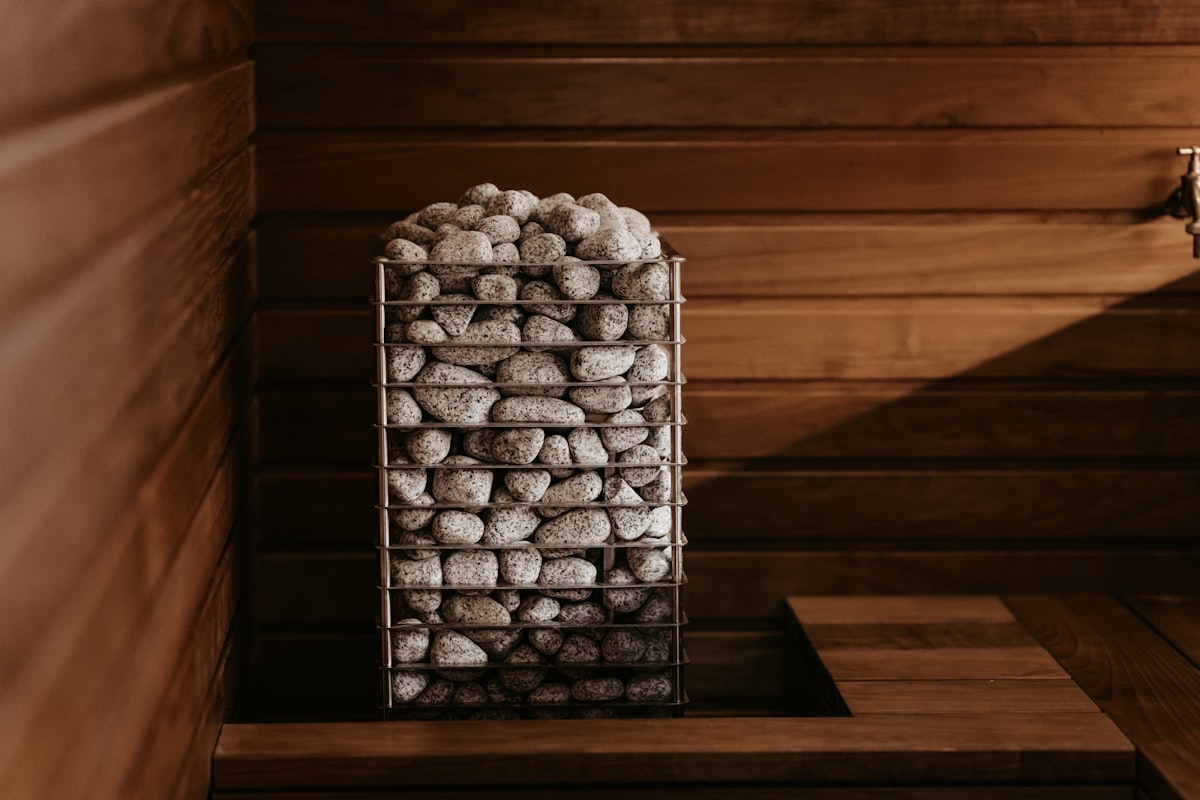
How to Choose the Right Sauna Rocks
Not all rocks belong in a sauna. The wrong choice can crack, shatter, or release harmful dust. Here's what to look for — and what to avoid.
Sauna rocks do one job: absorb heat from the stove and release it as löyly when water hits them. Get the wrong type and they can crack, shatter, or release harmful dust. Get the right ones and they'll produce smooth, consistent steam for years. Here's what to look for — and what to avoid.
What Makes a Good Sauna Rock
The ideal sauna rock is dense, non-porous, and thermally stable — meaning it can absorb and release heat repeatedly without cracking or spalling. It should also be free of minerals that release harmful gases when heated.
The Best Options
- Peridotite — The rock Misa uses in their wood-burning stoves, and the one we stock at Finnport. An ultra-dense igneous rock with outstanding thermal stability and heat retention. Handles the extreme temperature cycles of a wood-burning kiuas exceptionally well and produces excellent löyly. If you have a Misa stove, this is the natural choice for replacements.
- Olivine diabase — The other gold standard in Finland, used by many Finnish stove manufacturers. Mineralogically close to peridotite — dark grey, very dense, and highly resistant to thermal shock. Produces smooth, consistent steam.
- Soapstone (talc) — The premium choice for löyly quality. Heats up more slowly but holds heat longer and releases it in a notably softer, more even wave. Prized in Finland for the gentleness of the steam it produces.
- Basalt — Dense volcanic rock with excellent heat retention and strong resistance to thermal shock. Works reliably in both wood-burning and electric stoves. There's a local connection worth knowing: the dark igneous rock that caps the Nor'Wester Mountains south of Thunder Bay — the same rock that gives those flat-topped mesas their shape — is diabase, the coarser-grained cousin of basalt. The Lake Superior north shore and islands near Rossport are composed of volcanic basalt flows from the same ancient Midcontinent Rift that formed the Lake Superior basin over a billion years ago. The basalt sold commercially as sauna stones worldwide is geologically the same material found right here in Northwestern Ontario.
What to Avoid
Granite — Despite being widely suggested online, granite is not a good sauna rock. It is porous, often contains moisture pockets, and may have mica flakes that crack explosively under repeated heating. Finnish sauna manufacturers do not recommend it.
Sandstone and limestone — Sedimentary rocks that fracture unpredictably under heat. Never use them.
River rocks and field stones — Unless you can positively identify the rock type, avoid them. Unknown stones may contain trapped moisture, air pockets, or reactive minerals — any of which can cause a rock to crack or explode in a heated stove.
Rocks with a metallic or glassy appearance — These often contain minerals that oxidize or off-gas at sauna temperatures.
How Many Rocks Do You Need?
The amount is determined by your stove, not a general rule. Smaller heaters may call for as little as 20 kg, while larger wood-burning stoves — the kind where rocks fill the entire interior cavity — can require up to 100 kg. The capacity is specified by the manufacturer and is usually listed on the stove or in the manual. Under-fill and the heat is uneven; over-fill and air can't circulate through the rock bed properly. When in doubt, match the weight to what the stove was designed for.
When to Replace Them
The standard recommendation is every 1–3 years, but that figure is really tied to usage, not the calendar. A rough guide used by Finnish manufacturers is one full rock change per 100 sessions — so a sauna used three times a week needs fresh rocks sooner than a cottage sauna fired up a handful of times each summer.
Many older saunas are still running on the original rocks from decades ago. That's not necessarily a problem — condition is what matters, not age. If the rocks are still dense, dark, and producing good steam, they're doing their job.
The signs it's actually time to replace them:
- Rocks are crumbling or breaking apart
- Visible whitish, greenish, or blackish discolouration
- The stones feel noticeably lighter than they used to
- Tapping two stones together produces a hollow sound instead of a solid click
- Stone fragments are collecting at the bottom of the stove
- The sauna is taking longer than normal to reach temperature
Rock type affects longevity. Peridotite — the stone Misa uses and we stock at Finnport — lasts roughly twice as long as most other sauna rocks. It's one of the reasons it's worth buying quality stones from the start rather than replacing cheaper ones more often.
When you do replace: wash the new rocks, load them loosely so air can circulate, and heat the stove slowly the first two or three sessions to cure them in.